
As technology reshapes the business world, companies are rethinking how they handle finances to stay flexible and competitive. Remote financial services are at the forefront of this change, offering companies the flexibility, scalability, and convenience needed to thrive in a competitive market. More businesses now rely on virtual accounting services, online financial consulting, and cloud-based financial services to streamline operations and reduce overhead costs.
With the rise of remote work, advanced financial technology, and secure cloud platforms, financial services no longer require an in-house team or a brick-and-mortar office. Remote bookkeeping and accounting solutions enable businesses of all sizes to access expert financial support from anywhere in the world. In this comprehensive guide, we’ll dive deep into what remote financial services are, how they work, their benefits and drawbacks, and what the future holds for this rapidly growing sector.
Why Are More Businesses Using Remote Financial Services?
Quick answer: Remote financial services are finance and accounting functions, such as virtual bookkeeping, accounting, payroll, and consulting, delivered through secure cloud platforms rather than by an on-site team. Businesses use them to cut overhead, tap specialized expertise anywhere, scale support up or down, and get real-time financial data behind encryption and multi-factor authentication. Because the work is now location-independent, remote finance is a lasting shift rather than a temporary trend.
How Fast Is Remote Finance Growing?
Small businesses make up 99.9 percent of all U.S. businesses, and remote services give them enterprise-grade finance without the headcount. The Bureau of Labor Statistics reports that accountants and auditors earned a median annual wage of $81,680 in May 2024, with about 124,200 openings projected each year through 2034, so buying that expertise on demand is usually far cheaper than staffing it in-house. For a complete directory, see our small business bookkeeping hub. To compare specific models, read outsourced bookkeeping services, virtual bookkeeper for small businesses, and remote bookkeeping services.
What Are Remote Financial Services?
These services refer to the delivery of financial tasks and consulting through digital platforms without requiring in-person interaction. Our services cover a wide range of functions like online accounting, remote bookkeeping, strategic financial planning, payroll support, and beyond.
Instead of hiring an in-house team, businesses can now partner with remote professionals or firms that provide these services via the internet. Thanks to advancements in fintech and cloud-based software, remote financial services have become reliable, secure, and highly efficient.
Key Features:
- Cloud-based financial software (e.g., QuickBooks, Xero, FreshBooks)
- Secure data sharing and storage
- Remote collaboration tools (e.g., Slack, Zoom, Microsoft Teams)
- Scalable service models based on business needs
How Remote Financial Services Work
Remote financial services function through a combination of cloud computing, secure communication channels, and specialized financial software. Here’s a step-by-step look at how they typically work:
- Initial Consultation: The business meets with a remote financial provider virtually to assess needs.
- Onboarding Process: The client provides access to necessary financial data through secure portals.
- Data Integration: Cloud-based financial tools are synced with existing business platforms.
- Ongoing Services: Providers manage bookkeeping, accounting, payroll, or consulting remotely.
- Reporting and Review: Regular reports and virtual meetings ensure transparency and accuracy.
Types of Remote Financial Services
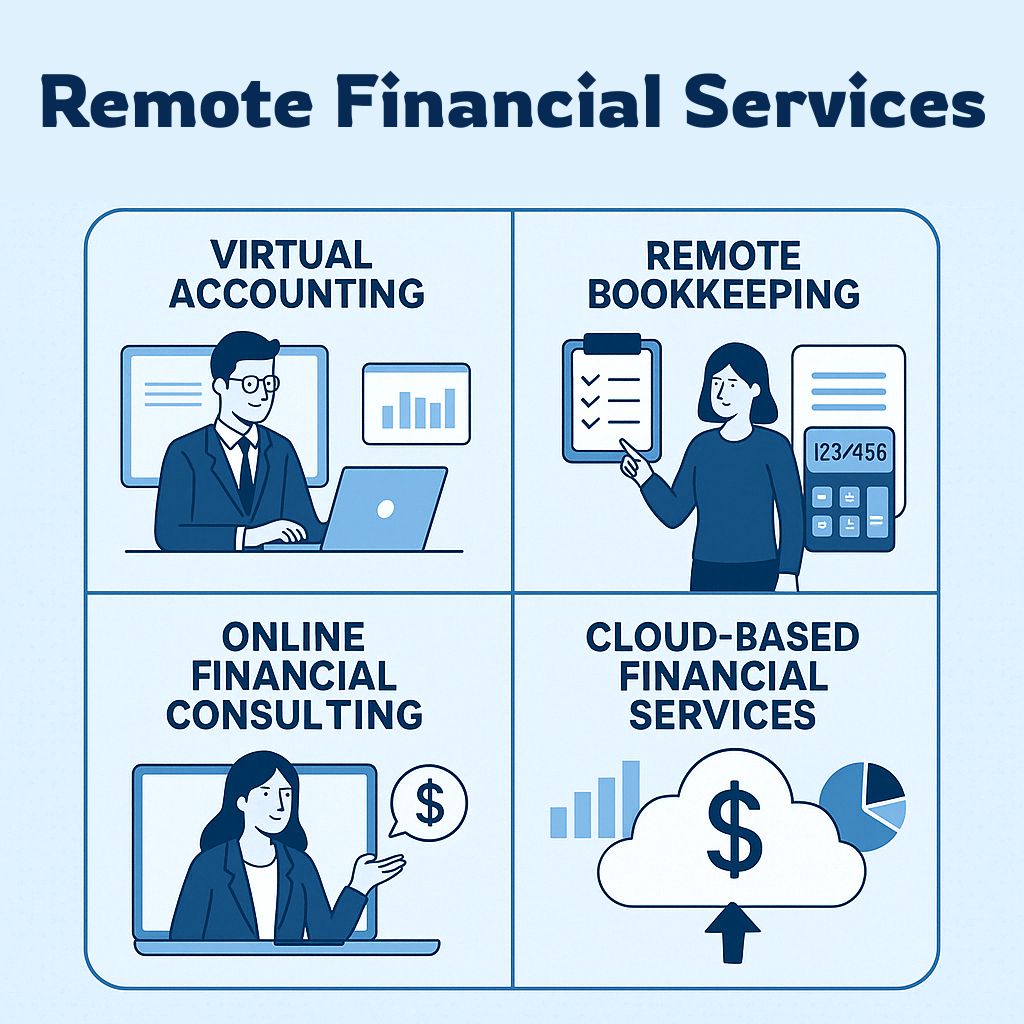
1. Virtual Accounting Services
These include day-to-day accounting, preparation of financial statements, and compliance support. Many businesses are now outsourcing accounting services for small businesses to certified professionals who use cloud-based systems for maximum efficiency.
2. Remote Bookkeeping
Bookkeepers manage invoices, expenses, payroll entries, and reconciliations remotely. Many businesses choose to outsource this task due to its time-consuming nature and the precision it requires.
3. Online Financial Consulting
Consultants provide strategic advice on budgeting, investment and business growth through online platforms, and for forward-looking cash and margin decisions many businesses layer in Remote CFO services.
4. Cloud-Based Financial Services
This encompasses all financial services delivered via cloud platforms, including automated billing, reporting dashboards, and AI-driven forecasting tools.
5. Remote Payroll Management
Service providers manage employee compensation and benefits processing without the need for in-person intervention.
Top Tools Used in Remote Financial Services
Technology is the backbone of remote financial services. Here are some top tools that professionals rely on to deliver accurate, efficient support, no matter where they are.
- QuickBooks Online: One of the most widely used platforms for small and mid-sized businesses. It offers everything from invoicing and payroll to tax reporting and financial dashboards.
- Xero: A cloud-based accounting software that’s user-friendly, with great integration options for ecommerce, inventory, and more.
- Gusto: Primarily used for payroll, benefits, and HR services. It’s a go-to for small businesses managing remote teams.
- FreshBooks: Designed for service-based businesses and freelancers. Offers time tracking, invoicing, and expense management with a clean interface.
- Wave: A free option perfect for freelancers and solopreneurs looking for basic accounting, invoicing, and receipt tracking.
- Slack + Zoom + Google Workspace: These aren’t financial tools, but they’re crucial for communication between businesses and remote finance professionals.
Using the right combination of these platforms can make a huge difference in how smooth and secure your remote financial operations are.
Remote vs. In-House Financial Services: A Quick Comparison
Here’s a quick breakdown to help you visualize the differences between traditional in-house financial services and their remote counterparts:
| Feature | In-House Financial Services | Remote Financial Services |
|---|---|---|
| Cost | Higher (salaries, benefits) | Lower (subscription or contract) |
| Flexibility | Limited to work hours | Available on-demand |
| Access to Talent | Local only | Global pool of professionals |
| Software & Tools | May require manual updates | Often includes cloud-based tools |
| Scalability | Slower, depends on hiring | Easily scalable as you grow |
| Security & Compliance | Managed internally | Often built-in with providers |
Remote services not only offer better flexibility, but they also allow you to choose exactly what you need without committing to full-time hires. Plus, with real-time data access and integrated tools, businesses can make faster, smarter decisions.
Advantages of Remote Financial Services
1. Cost Efficiency
Outsourcing financial tasks helps reduce the cost of hiring, training, and maintaining an in-house team.
2. Access to Expertise
Businesses can work with certified professionals who specialize in specific industries or financial tasks.
3. Scalability
Remote services can be scaled up or down based on business size and seasonal needs.
4. Time Savings
Automated tools and professional oversight allow businesses to focus on core operations.
5. Real-Time Data Access
Cloud-based systems offer up-to-date financial insights from anywhere, at any time.
6. Enhanced Security
Advanced encryption and multi-factor authentication protect sensitive financial data.
Example Scenario: How a Small Retailer Cuts Finance Overhead
Here is what the switch typically looks like for a small retailer. The business is profitable but stretched: an owner is juggling outdated desktop accounting software, manual payroll, and month-end reports that arrive late.
Moving to a remote bookkeeping service on cloud-based software usually changes three things. Daily sales, payroll, and expenses flow into one system, so reconciliations no longer pile up. Payroll runs on a schedule instead of by hand, which reduces errors. Monthly reports arrive on time, so the owner can see margins and cash before making buying or hiring decisions.
The practical benefit is that the owner does not need to hire an in-house accountant or invest in expensive systems to get reliable numbers. For real, named engagements with specific outcomes, see our case studies.
Disadvantages of Remote Financial Services
1. Limited Face-to-Face Interaction
Not having face-to-face interactions can sometimes make it harder to communicate clearly and build strong working relationships.
2. Dependence on Technology
Any technical disruptions or software issues can delay service delivery.
3. Data Privacy Concerns
Although most platforms are secure, there is always a potential risk of data breaches.
4. Time Zone Challenges
Working with international providers can lead to scheduling difficulties.
Who Should Use Remote Financial Services?
Remote financial services are ideal for:
- Startups looking to minimize overhead costs
- Small businesses without in-house financial departments
- Freelancers and solopreneurs needing occasional support
- Growing companies aiming to scale efficiently
- Enterprises seeking specialized financial insights or audits
These services can be customized for various industries, including tech, retail, healthcare, and manufacturing.
How Different Businesses Use Remote Financial Services
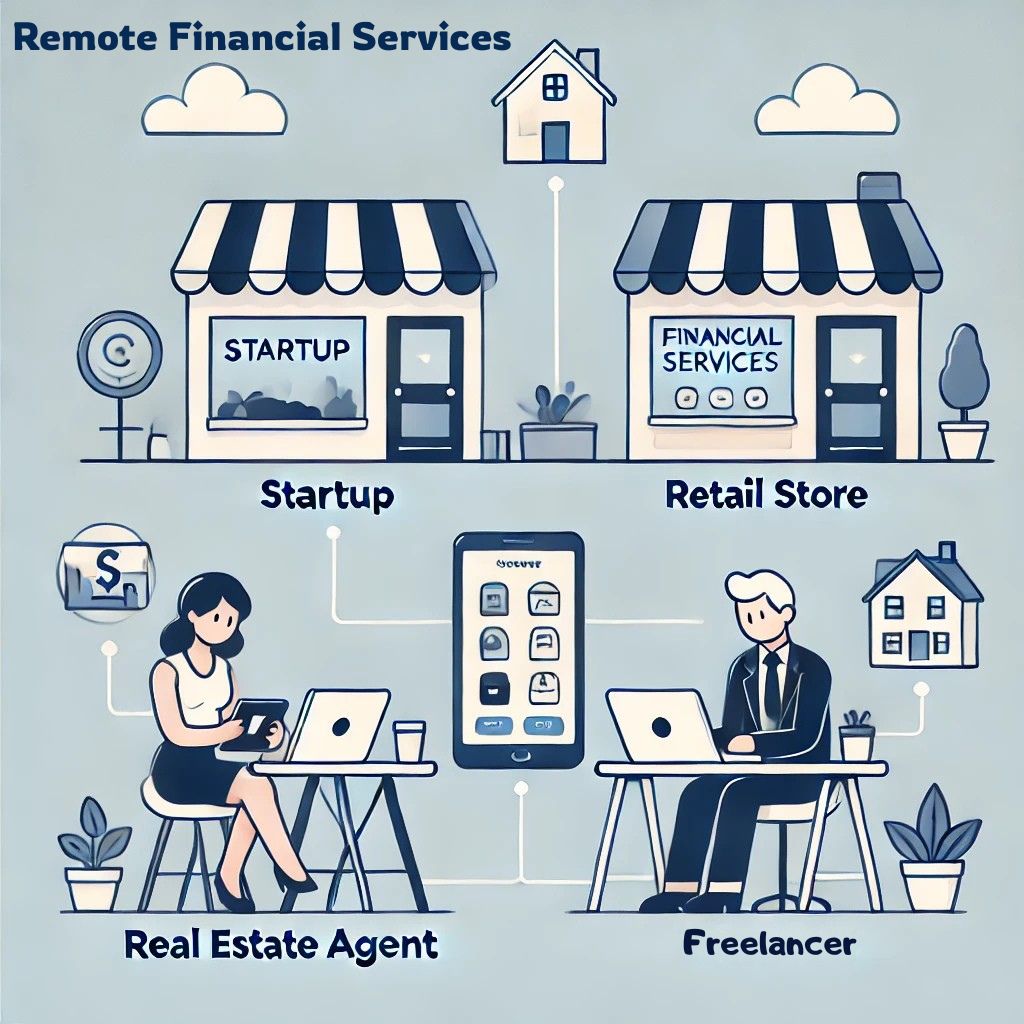
Remote financial services are not one-size-fits-all, they’re incredibly adaptable, which is why businesses of all shapes and sizes are embracing them.
Startups often rely on virtual accounting services right from the beginning. Since they’re working with lean teams and limited resources, outsourcing tasks like bookkeeping and payroll allows them to focus on product development and growth instead of paperwork.
Retail stores benefit from remote bookkeeping to manage sales data, inventory expenses, and vendor invoices, all without hiring an in-house accountant. Paired with tools like Shopify and cloud accounting platforms, financial tasks are automated and tracked in real time.
Real estate businesses often use online financial consulting and cloud-based tools to manage property-related income and asset tracking. Having remote experts handle the numbers while they focus on client relations saves time and reduces costly errors.
Even freelancers and solopreneurs find value in using cloud platforms to send invoices, track deductions, and prepare for tax season. No matter the size or stage, remote financial services provide scalable support for every type of business.
Overcoming Implementation Hurdles: Transitioning to Remote Financial Services
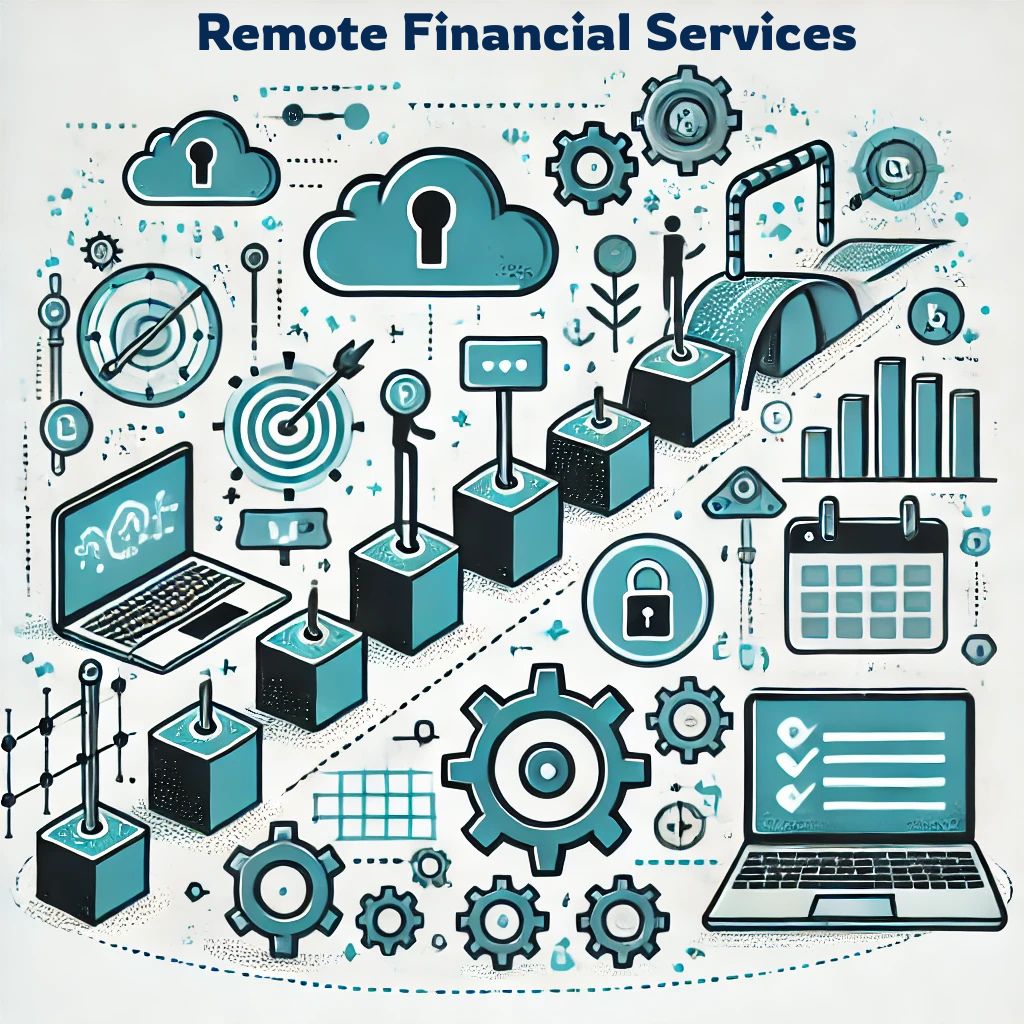
As the shift to remote financial services gains momentum, businesses of all sizes must navigate the complexities of integration. While the benefits of flexibility, cost-efficiency, and scalability are clear, the process of adopting remote services can come with its own set of challenges. Here’s a closer look at some of the most common hurdles businesses face during the transition and how to overcome them.
1. Navigating Technological Transition
For businesses used to traditional, in-house financial management, the technological leap to cloud-based platforms can be overwhelming. Legacy systems often rely on manual processes and local software, making it hard to see the immediate value of a remote system. Adopting new technology may initially be met with resistance from employees or managers who are accustomed to the old ways.
How to Overcome It: It’s crucial to set up a phased approach. Start by introducing easy-to-use, familiar platforms like QuickBooks or Xero that offer simple integrations with existing tools. Providing comprehensive onboarding and training programs, along with a dedicated support team, can help smooth the transition. Additionally, working with a provider who specializes in migration services can ensure that no financial data is lost during the switch.
2. Data Security Concerns
One of the top concerns when adopting remote financial services is ensuring the security of sensitive business data. While most remote service providers prioritize robust cybersecurity measures, such as encryption and multi-factor authentication, businesses still need to be proactive in managing data security within their own organizations.
How to Overcome It: Businesses should set up internal guidelines that reinforce the importance of secure data management. Encouraging strong password policies, implementing data access controls, and regularly updating security protocols can mitigate risks. Moreover, choosing a remote financial provider with a strong track record of security certifications and compliance can help businesses feel confident in their decision.
3. Maintaining Communication in Virtual Environments
Remote financial services require seamless communication between business owners and service providers. However, without face-to-face interactions, misunderstandings can occur, or critical information can be overlooked. Clear and effective communication is essential for smooth financial operations.
How to Overcome It: Establishing a clear communication framework is key. Utilize tools like Slack or Microsoft Teams for real-time messaging and set up regular virtual meetings via Zoom or Google Meet to discuss ongoing progress and upcoming deadlines. Encouraging a collaborative approach and ensuring that both parties are on the same page about expectations can help maintain clarity and efficiency.
4. Adapting to Remote Work Culture
When transitioning to remote financial services, businesses must also adapt to a remote work culture, which may require a shift in mindset. This includes learning how to collaborate effectively without being in the same physical space and trusting remote professionals with important financial decisions.
How to Overcome It: Building trust in remote relationships is crucial. Begin by clearly outlining roles, expectations, and deliverables upfront. Leverage cloud-based collaboration tools to ensure that all parties have access to the latest data and can communicate easily. Over time, businesses that foster a culture of accountability and transparency will experience smoother operations with their remote financial teams.
5. Managing Time Zone Differences
For businesses working with remote financial providers located in different time zones, scheduling meetings or receiving timely responses to questions can become challenging. This can be particularly troublesome if urgent decisions need to be made quickly or if real-time collaboration is required.
How to Overcome It: One of the best ways to handle time zone differences is to establish overlapping hours for communication. Setting a window of time that works for both parties, ideally during business hours for both locations, ensures that teams can collaborate in real-time. For any urgent matters, rely on asynchronous communication like email or project management tools, which allow both sides to work on tasks at their convenience without waiting for a live interaction.
Embracing AI and Automation in Remote Financial Services
Artificial Intelligence (AI) and automation are two of the most exciting technological trends transforming the remote financial services landscape. By harnessing these tools, businesses can streamline processes, reduce human error, and gain valuable insights into their financial health, without the need for full-time staff.
AI-Powered Insights for Strategic Decision-Making
AI is increasingly used to analyze business data, offering deeper insights into financial patterns and forecasting. With the help of AI tools integrated into cloud-based platforms, businesses can receive real-time data analysis that would be nearly impossible to generate manually. This technology not only helps businesses track their current financial standing but also makes it easier to predict future trends, such as cash flow or sales projections.
By using AI-driven analytics, businesses can identify patterns that might otherwise go unnoticed, enabling them to make informed decisions on budgeting, investments, and even operational scaling. As AI continues to improve, businesses will be able to make faster, data-driven decisions, giving them a competitive edge in their respective industries.
Automating Time-Consuming Financial Tasks
Another area where AI and automation are making waves is in the automation of routine financial tasks. From expense reporting to invoicing and financial reconciliation, these repetitive processes take up a significant amount of time and are prone to human error. AI can automate these functions, ensuring consistency and accuracy while freeing up resources for higher-level tasks.
For instance, platforms like Xero and QuickBooks utilize automation for tasks like invoice generation, reconciliation of accounts, and expense categorization. Businesses can even set up automated reminders for payments or recurring expenses, reducing the administrative burden on finance teams.
Enhancing Accuracy and Reducing Errors
AI’s ability to learn from past data allows it to identify and correct errors in financial transactions. For example, AI-powered tools can catch discrepancies in invoices, ensure proper tax categorization, and detect inconsistencies across different accounting records. This minimizes the risk of costly mistakes and helps businesses maintain more accurate financial records without manual oversight.
In the long run, AI-enhanced accuracy also reduces the amount of time spent on audits or correcting mistakes, which means fewer disruptions to business operations.
Where Remote Finance Is Heading
Remote financial services keep evolving with technology and the changing demands of the market. A few shifts are shaping the next phase:
AI and automation
More firms use AI for real-time analytics, forecasting, categorization, and fraud detection, and automation tools now handle predictive cash flow analysis, not just data entry. This lets small businesses manage finances with fewer manual hours and fewer errors.
Blockchain and secure transactions
Blockchain, known for its security and transparency, is making early inroads into financial reporting and transactions. Adoption is still limited for most small businesses, but it points toward more transparent, fraud-resistant recordkeeping over time.
More specialized remote consultants
As the financial landscape grows more complex, businesses increasingly seek specialized expertise. Remote consultants offer tailored advice on strategic planning, risk management, and reporting, relying on advanced analytics and real-time data to make actionable recommendations.
Mobile and global finance
Apps let owners manage budgets, pay bills, and track expenses on the go, while inventory management systems for small businesses add real-time stock tracking that integrates with cloud accounting. At the same time, companies increasingly source financial talent globally to access diverse expertise at lower cost.
FAQs About Remote Financial Services
1. What are the most popular remote financial services for small businesses?
Virtual accounting, remote bookkeeping, and payroll management are top choices.
2. Are remote financial services secure?
Yes, most providers use encryption, two-factor authentication, and secure data centers.
3. How do I choose the right remote financial provider?
Look for certifications, client reviews, software compatibility, and industry experience.
4. How do virtual accounting services differ from traditional ones?
The main difference is delivery: virtual services are managed remotely via cloud platforms, while traditional ones often require physical presence.
Conclusion
These services offer a future-ready solution for businesses seeking flexibility, efficiency, and expert support without the overhead of in-house teams. By leveraging virtual accounting services, online financial consulting, remote bookkeeping, and cloud-based financial services, companies can stay agile and competitive in the digital age.
Adopting remote financial services is not just a convenience, it is a practical way to get reliable numbers and senior guidance without a full in-house team. Whether you are a startup or an established enterprise, the tools and talent you need are a click away. To see what the right mix looks like for your business, book a discovery call with Remote Financial Services.