
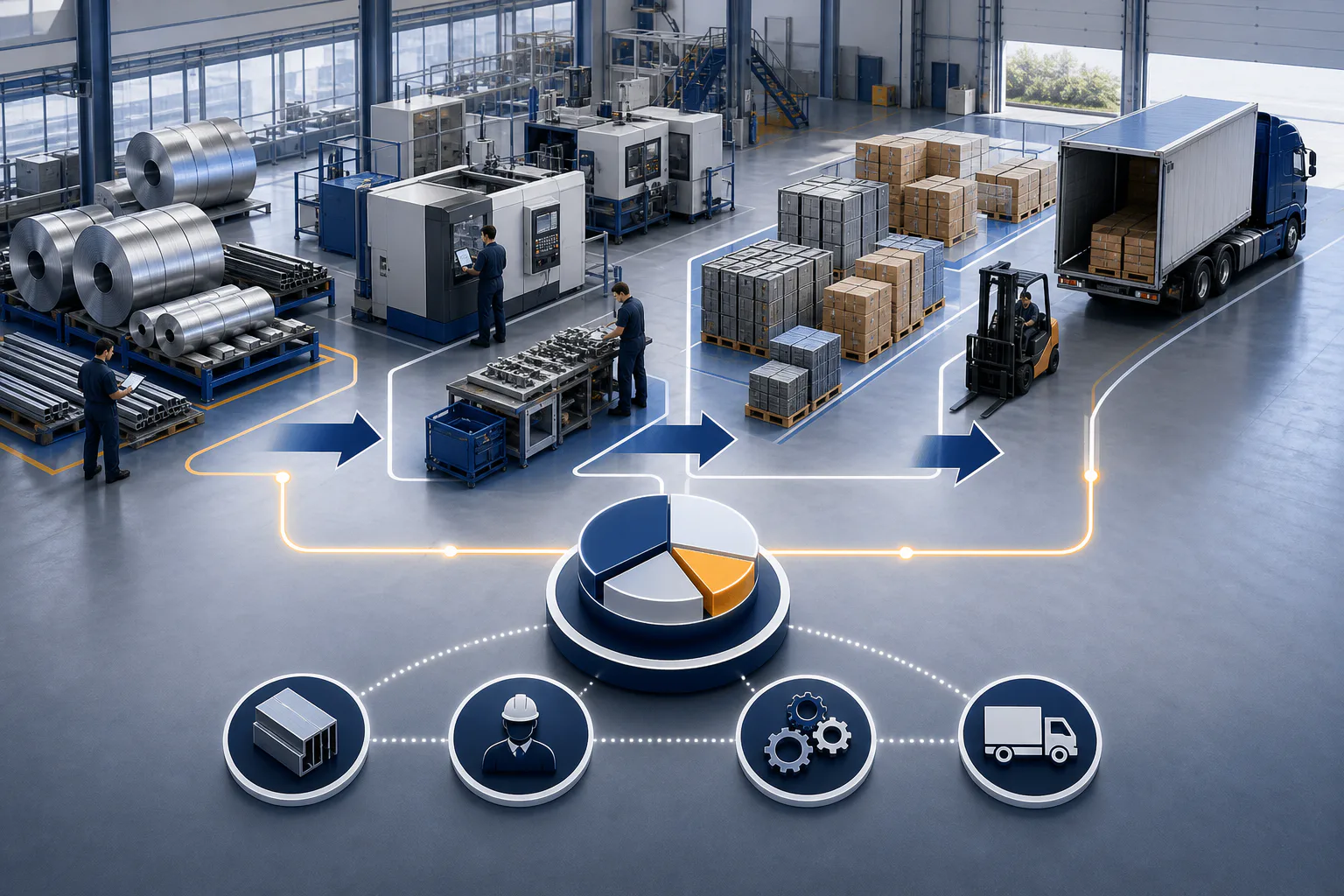
Manufacturing accounting is the set of book and tax methods a US manufacturer uses to track production costs through three inventory stages — raw materials, work in process (WIP), and finished goods — so that cost of goods manufactured (COGM), cost of goods sold (COGS), and per-unit margins are correct. It applies to any US business that makes tangible products, from machine shops to food processors. The biggest decision boundary: your US Generally Accepted Accounting Principles (GAAP) books, your federal tax method, and your internal cost reports are three different views of the same factory costs, and 2026 federal tax thresholds decide how simple the tax view is allowed to be.
Quick answer
Track three inventory accounts. Direct materials and direct labor attach to products as they are made; manufacturing overhead — factory rent, utilities, indirect labor, depreciation, and supervision — is allocated to products with a predetermined rate. Costs roll forward monthly: materials used, plus labor and applied overhead, move through WIP into finished goods, and become COGS only when units sell. Under US GAAP, inventory carries full absorbed production cost and is measured at the lower of cost and net realizable value. For federal tax, qualifying small manufacturers may use simplified inventory methods and skip the uniform capitalization (UNICAP) rules — the gross-receipts ceiling is $32 million for tax years beginning in 2026, indexed for inflation each year. For the wider sector context, see our industry finance guides for small businesses.
What makes manufacturing accounting different?
A reseller buys finished goods and sells them. A manufacturer converts inputs, so costs must be collected while conversion is happening. Three cost categories do the work:
- Direct materials — materials that become part of the product and are conveniently traced to it (steel, resin, fabric, packaging that ships with the unit).
- Direct labor — wages and related costs of the people who touch the product (machinists, assemblers, welders).
- Manufacturing overhead — every other factory cost: production supervision, indirect labor, factory rent and utilities, equipment depreciation, maintenance, and factory supplies.
Those costs accumulate in three balance-sheet accounts: raw materials, WIP (units still in production), and finished goods (units complete and unsold). Nothing hits COGS until a sale occurs. This staging is what makes manufacturing bookkeeping harder than service or retail bookkeeping — and why a monthly close that never counts WIP cannot produce a trustworthy margin.
Which accounting rules apply to a US manufacturer?
Keep three bases separate before touching the numbers.
US GAAP books. Manufactured inventory is carried at full absorbed cost — direct materials, direct labor, and an allocated share of manufacturing overhead — not at direct cost alone. After initial measurement, the Financial Accounting Standards Board (FASB) requires inventory measured by first-in, first-out (FIFO) or average cost to be stated at the lower of cost and net realizable value (NRV); inventory under last-in, first-out (LIFO) or the retail method still uses the older lower-of-cost-or-market test, per FASB Accounting Standards Update 2015-11 (Topic 330) (accessed July 27, 2026). The Board states:
“An entity should measure inventory within the scope of this Update at the lower of cost and net realizable value.” — Financial Accounting Standards Board, ASU 2015-11
ASU 2015-11 defines NRV as “estimated selling prices in the ordinary course of business, less reasonably predictable costs of completion, disposal, and transportation.” In practice: when a SKU’s expected selling price no longer covers its cost plus completion and selling costs, write the inventory down and book the loss in that period.
Federal tax. Where inventory is an income-producing factor, the default rule in IRS Publication 538 (accessed July 27, 2026) is strict:
“If an inventory is necessary to account for your income, you must use an accrual method for purchases and sales.” — Internal Revenue Service, Publication 538
On top of accrual inventory accounting, Internal Revenue Code section 263A — the uniform capitalization rules — layers additional indirect-cost capitalization for producers: per IRS Publication 538 (accessed July 27, 2026), those rules require capitalizing direct costs and part of the indirect costs for production or resale activities.
The small-business escape hatch runs through the section 448(c) gross-receipts test: a non-tax-shelter business meeting it can treat inventory as non-incidental materials and supplies, or simply follow its book treatment of inventory, and is exempt from section 263A (sections 471(c) and 263A(i), as described in IRS Publication 334, accessed July 27, 2026). For tax years beginning in 2026, that test is met when average annual gross receipts for the prior three tax years do not exceed $32 million, per IRS Revenue Procedure 2025-32 (accessed July 27, 2026).
Management reporting. Internal job-cost and product-line reports are unregulated, but they should reconcile to the same underlying costs, or quoting and pricing decisions drift from reality. A business can simultaneously keep full-absorption GAAP books, elect a simplified tax method, and run a leaner internal view — as long as someone maps the differences. State income tax rules add one more layer, because states conform to federal accounting-method and inventory provisions to different degrees; check the states where you file.
How do you allocate manufacturing overhead?
The standard technique is a predetermined overhead rate, computed before the period begins:
Predetermined overhead rate = estimated annual manufacturing overhead ÷ estimated annual allocation base
The allocation base should track what actually drives your overhead — direct labor hours for labor-intensive shops, machine hours for automated ones. The worked numbers below are a hypothetical illustration with made-up inputs for a fictional US brass-valve manufacturer, presented as a US GAAP book view, not a tax computation.
Inputs: estimated annual overhead of $360,000 and 20,000 estimated annual direct labor hours, so the rate is $360,000 ÷ 20,000 = $18.00 per direct labor hour. In August 2026 the shop logged 1,600 direct labor hours, so applied overhead is 1,600 × $18.00 = $28,800. Actual August overhead totaled $29,000.
Table 1: Hypothetical August 2026 manufacturing overhead — actual incurred vs. applied (made-up inputs, USD).
| Overhead line | Actual amount |
|---|---|
| Factory rent | $6,500 |
| Factory utilities | $2,800 |
| Indirect labor | $9,200 |
| Equipment depreciation | $4,000 |
| Factory supplies | $1,500 |
| Production supervision | $5,000 |
| Total actual overhead | $29,000 |
| Applied to WIP (1,600 hours × $18.00) | $28,800 |
| Underapplied overhead | $200 |
Interpretation: applied overhead fell $200 short of actual, so overhead is underapplied — the shop absorbed slightly less cost into inventory than it spent. Small balances like this are typically closed to COGS at period end; large ones signal a stale rate or a volume miss and should be prorated across WIP, finished goods, and COGS. Revisit the rate whenever wages, utility tariffs, or production volume shift materially.
How do costs roll forward from raw materials to COGS?
Continuing the same hypothetical shop (made-up inputs, USD): August began with $18,000 of raw materials, $42,000 of materials purchases arrived, and the month-end count showed $16,000 on hand. Direct labor cost $44,800 (1,600 hours × $28.00). WIP started at $22,000 and the costed month-end WIP count was $19,600. Finished goods started at $30,000 (1,000 valves at $30.00); 4,000 valves were completed and 3,900 sold at $55.00 each.
Table 2: Direct materials rollforward, August 2026.
| Step | Amount |
|---|---|
| Beginning raw materials | $18,000 |
| Plus purchases | $42,000 |
| Less ending raw materials | ($16,000) |
| Direct materials used | $44,000 |
Table 3: WIP rollforward to cost of goods manufactured, August 2026.
| Step | Amount |
|---|---|
| Beginning WIP | $22,000 |
| Plus direct materials used | $44,000 |
| Plus direct labor | $44,800 |
| Plus applied manufacturing overhead | $28,800 |
| Less ending WIP | ($19,600) |
| Cost of goods manufactured (COGM) | $120,000 |
Table 4: Finished goods rollforward to adjusted COGS and gross profit, August 2026.
| Step | Amount |
|---|---|
| Beginning finished goods | $30,000 |
| Plus COGM | $120,000 |
| Goods available for sale | $150,000 |
| Less ending finished goods (1,100 units × $30.00) | ($33,000) |
| Unadjusted COGS | $117,000 |
| Plus underapplied overhead (Table 1) | $200 |
| Adjusted COGS | $117,200 |
| Revenue (3,900 units × $55.00) | $214,500 |
| Gross profit | $97,300 |
Interpretation: COGM of $120,000 over 4,000 completed units gives a unit product cost of $30.00 per valve, which prices ending finished goods consistently. Adjusted COGS of $117,200 against $214,500 of revenue leaves a gross margin of about 45.4%. Note what the rollforward protects against: $117,600 of new production cost entered the system in August ($44,000 materials + $44,800 labor + $28,800 overhead), yet $52,600 of cost still sits on the balance sheet at month end as WIP ($19,600) and finished goods ($33,000). Expensing factory costs as paid would have distorted both the balance sheet and the month’s margin. For the standalone formula and tax-form mapping behind the final step, see our walkthrough of the cost of goods sold formula; corporations and partnerships report the result on Form 1125-A — the IRS notes that filers of Forms 1120, 1120-C, 1120-F, 1120S, and 1065 “complete and attach this form if they report a deduction for cost of goods sold” (About Form 1125-A, accessed July 27, 2026).
What does a monthly manufacturing close look like?
Table 5: Manufacturing monthly close map — tasks and outputs.
| Step | Close task | Output |
|---|---|---|
| 1 | Count raw materials (or reconcile perpetual records to a cycle count) | Verified ending raw materials |
| 2 | Post materials issued to production | Direct materials used |
| 3 | Post direct labor from timekeeping or payroll | Labor cost by job or line |
| 4 | Record actual overhead; apply overhead at the predetermined rate | Applied vs. actual comparison |
| 5 | Cost the ending WIP count by stage of completion | Ending WIP value |
| 6 | Complete the WIP rollforward | COGM |
| 7 | Roll finished goods to COGS | Unadjusted COGS |
| 8 | Dispose of over- or underapplied overhead | Adjusted COGS |
| 9 | Test slow or obsolete stock for NRV write-down | Write-down entry, if needed |
| 10 | Review product-line margins against prior months | Variance notes for management |
Run in order, these ten steps turn shop-floor activity into statements an owner can price from. Steps 1, 5, and 9 fail most often in practice because they need physical counts and honest NRV estimates, not just bank feeds. Reliable counts usually depend on the systems upstream of the ledger — see our guide to inventory management systems that keep stock data and the books in sync. For a real-world example of the payoff, RFS built product-line cost tracking across raw materials, labor, packaging, freight, and overhead for a Miami, Florida manufacturer and exporter, giving its sales team more reliable cost data for international quotes.
Where do manufacturing books usually go wrong?
- Expensing factory costs as period costs. Rent, depreciation, and supervision belong in inventory under full absorption, not straight to the income statement.
- Plugging WIP. If ending WIP is guessed, COGM and every downstream margin are guesses too.
- Mixing bases. Electing a simplified tax method under section 471(c) does not change what GAAP books or useful internal cost reports require.
- Letting the overhead rate go stale. A rate set once and never trued up produces large, misleading variances.
- Missing NRV write-downs. Obsolete SKUs carried at full cost overstate inventory and profit.
- Dropping inbound freight and similar costs out of material cost, which understates unit cost and overstates margin.
FAQs
What is the difference between COGM and COGS?
Cost of goods manufactured is the total production cost of units completed during the period — the output of the WIP rollforward. Cost of goods sold is the cost of the units actually sold, after moving completed units through finished goods. A month can have high COGM and low COGS if finished units pile up in the warehouse.
Does manufacturing overhead go on the balance sheet or the income statement?
Under full-absorption GAAP accounting, overhead is allocated into WIP and finished goods on the balance sheet first, and reaches the income statement only as part of COGS when the related units sell. The same capitalization logic applies for federal tax under section 263A unless the business qualifies for the small business taxpayer exemption.
Can a small manufacturer use cash-basis accounting?
For federal tax, a qualifying small business taxpayer — generally, one meeting the section 448(c) gross-receipts test ($32 million for tax years beginning in 2026) — may use the cash method and simplified inventory treatment. GAAP financial statements, however, are accrual-based, and lenders or investors may still expect them. The tax election and the book basis are separate decisions.
Does the small-business gross-receipts ceiling change?
Yes. The section 448(c) dollar amount is indexed for inflation annually: it was $31 million for 2025 and is $32 million for tax years beginning in 2026, per IRS Revenue Procedure 2025-32. Re-check the current inflation-adjustment revenue procedure each year before relying on a figure, and confirm eligibility — including the tax-shelter exclusion and the three-year averaging rule — with a tax professional before changing methods.
Is LIFO allowed for a US manufacturer?
Yes — US GAAP and the Internal Revenue Code both permit LIFO, unlike IFRS. Small manufacturers more often use FIFO or weighted-average cost; under ASU 2015-11, FIFO and average-cost inventory is measured at the lower of cost and net realizable value, while LIFO and retail-method inventory keep the lower-of-cost-or-market test. Method changes generally require IRS approval on Form 3115.
The bottom line
Set up three inventory accounts, allocate overhead with a current predetermined rate, and close every month with the rollforward: materials used, through WIP to COGM, through finished goods to adjusted COGS. Then confirm which tax basis your business qualifies for in 2026 — the simplified small-taxpayer methods or full UNICAP — and keep that election separate from your GAAP and management views. If your close cannot produce a clean WIP rollforward and a defensible overhead rate, the fix is structural: our remote bookkeeping services can help you structure a manufacturing close that produces trustworthy product costs every month. For adjacent topics, see the cost of goods sold formula guide and our industry finance guides for small businesses.
This article provides general educational information, not tax, legal, or accounting advice. Federal thresholds and IRS guidance cited here are as of July 27, 2026, and change over time; state rules vary. Consult a qualified tax professional who understands your facts before electing or changing any accounting method.